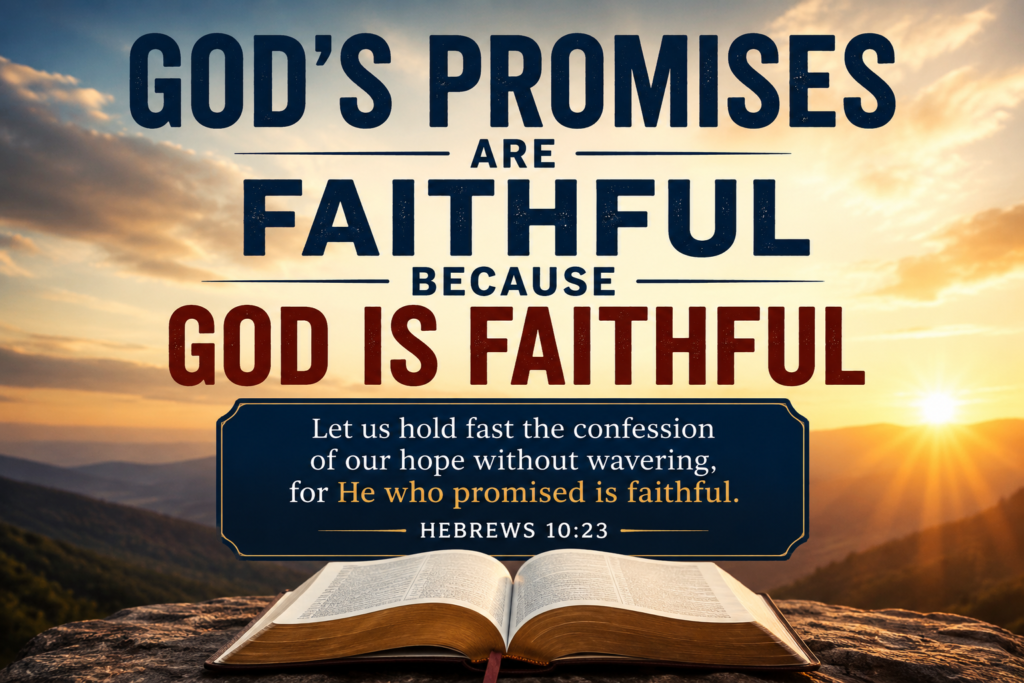

The session focused on God’s faithfulness as the foundation of His promises, drawing from Numbers 23:19, Joshua 21:45, Hebrews 10:23, Philippians 1:6, and 1 Kings 6:12. Key themes established: God cannot lie, He completes what He promises, and some promises are conditional — requiring obedience and surrender from believers. The session concluded with a call to personal commitment modeled on Joshua 24:15.
- Core theological point confirmed: God’s promises are reliable because His character is unchanging — He does not lie, exaggerate, or fail to complete what He says.
- Conditional vs. unconditional promises distinguished: Some promises require human obedience as a prerequisite (“if… then” structure in 1 Kings 6:12).
- Application affirmed: Problems believers face are generally not God’s failure but a result of not living and trusting according to His Word.
Key Teaching Points
- Num 23:19 — God is not a man that He should lie; He is truthful where humans are prone to sin and deception.
- Joshua 21:45 — All of God’s promises to Israel came to pass; none failed — extended as evidence of God’s faithful character for believers today.
- Hebrews 10:23 — Grounds for holding fast to the confession of hope without wavering, because God is faithful to what He said.
- Phil 1:6 — God who began a good work will complete it; sanctifying work continues until the day of Christ.
- 1 Kings 6:12 — Conditional structure (“if you walk… then I will establish”): obedience has a direct relationship with receiving God’s promises.
Illustrations Used
- Bank check analogy: Salvation compared to a check drawn from the “bank of heaven” — Jesus Christ paid the full amount; believers sign by faith, surrendering ownership of their lives to God.
- Garden of Eden warning: Satan convinced Eve that God was unfaithful to His word; their disobedience introduced sin and separation into the human race — demonstrating the cost of doubting God’s promises.
- Pharisees / Roman Catholic contrast: Historical examples of human additions to God’s Word, used to warn against substituting loyalty to men’s teachings for loyalty to Scripture.
Closing Challenge
- Believers urged to choose who they will serve, echoing Joshua’s declaration: “As for me and my house, we will serve Yahweh.”
- Four self-examination questions posed: Are you listening, reading, understanding, and obeying?
- God’s promises should not be treated as insignificant — some apply today, some extend into eternity
Full message
GOD’S PROMISES ARE FAITHFUL BECAUSE GOD IS FAITHFUL
— A Teaching Message —
|
Main Truth |
Main Texts
|
Numbers 23:19 |
Joshua 21:45 |
|
Hebrews 10:23 |
Philippians 1:6 |
|
1 Kings 6:12 |
Joshua 23:14 |
|
Joshua 24:15 |
Introduction: Conditional Promises and the Character of God
Last time, we looked at what we could call conditional promises. We considered 1 John 1:9, where God promises forgiveness and cleansing if we confess our sins.
That is a real promise. God truly forgives. God truly cleanses. But the promise includes our honest response before Him. We must repent, confess, and say the truth about our actions before God.
But before we talk more about our responsibility, it is better to first understand the character of the God who makes the promises.
- A promise is only as strong as the person who makes it.
- If a man lies, his promises cannot be trusted.
- If a man exaggerates, his words are uncertain.
- If a man forgets, his promises may fail.
- If a man is weak, he may want to fulfill his word but not have the power to do it.
- But God is not like man. Numbers 23:19.
Prayer
Heavenly Father, we thank You that we can come before You with complete assurance. The way to Your heart has been opened to us through our Lord and Savior, Jesus Christ.
Help us to understand more of who You are and how You deal with Your children. Encourage us in our walk with You. Strengthen us to speak honestly, clearly, and powerfully to others about who You are, who they are, and what we have in Christ through the riches of Your grace.
Thank You that we can be connected together around Your Word. I pray that Your Word would spread powerfully among many men, women, young people, families, and churches throughout India and beyond.
In Jesus’ name, amen.
1. God Is Not Like Man
|
Numbers 23:19 |
This verse tells us something very important about God’s character.
- God is much higher than we are.
- God is not like us.
- God does not lie.
- God does not bend the truth.
- God does not exaggerate.
- God does not make promises He cannot keep.
- We are prone to lie.
- We are prone to bend the truth for our own advantage.
- We are prone to say things and not complete them.
- We are prone to make promises and then forget them.
- But God is not like man.
That should make us thankful. We are not following a faith that depends only on what men say. We are not building our hope on human opinions, religious traditions, church history, or the authority of religious leaders.
We are resting our faith on the character and Word of God.
This is important because men often add to what God has said. The Pharisees did this in the days of Jesus. They added human commandments to the Word of God and created loyalty to themselves instead of loyalty to God’s truth.
This same danger can happen in many religious systems. It can happen among Catholics, Hindus, Baptists, pastors, missionaries, and churches. None of us are above this danger.
- So we must be careful.
- We must not teach people to depend on our opinions.
- We must not build loyalty to ourselves.
- We must not add our commandments to God’s Word.
- We must lead people back to the Scriptures.
- God’s promises are faithful because God is faithful to what He says.
2. God Does What He Says
|
Joshua 21:45 |
Numbers 23:19 tells us that God does not lie. Joshua 21:45 takes the truth one step farther.
God not only speaks. God completes what He says. God finishes His promises.
In Joshua 21:45, the verse is speaking specifically about God’s promises to the house of Israel. The Lord had promised certain things to Israel, and everything God had promised up to that time came to pass.
Not one word failed.
This does not mean every future prophecy in the Bible had already been fulfilled. It means that everything God had promised for that time and situation had been completed faithfully.
- This teaches us something about God’s character.
- God does not forget His promises.
- God does not begin and then fail to finish.
- God does not speak and then lack the power to complete His Word.
- What God promises, God fulfills.
3. Our Hope Is Secure Because God Is Faithful
|
Hebrews 10:23 |
This verse gives us a strong reason to continue.
We are told to hold fast. That means we should not let go. We should not abandon our confession. We should not turn back from our hope in Christ.
- But why can we hold fast?
- Not because we are strong in ourselves.
- Not because our feelings never change.
- Not because we never struggle.
- Not because we understand everything.
- We hold fast because He who promised is faithful.
- Our hope is only as strong as the One we are trusting.
- A person can be very sincere and still be wrong.
- A person can strongly believe something that is false.
- A person can place confidence in something that cannot save him.
- But when our hope is in God, our hope is secure.
We will never be able to point our finger at God and accuse Him of being unfaithful to His Word. God will never fail His promises. God will never betray His people. God will never forget what He has said.
So we hold fast.
4. God Will Finish the Work He Began in Us
|
Philippians 1:6 |
Paul had confidence for the believers in Philippi. But his confidence was not first in them. His confidence was in God.
Paul was saying, in so many words:
- God is not finished with me.
- God is not finished with you.
- God began this work, and God will complete it.
When God saves a sinner, He begins a good work. He opens our eyes to the truth. He shows us our sin. He brings us to the invitation of salvation. We turn from sin and self, and we trust only in Christ.
Then God continues His work in us.
- He sanctifies us.
- He matures us.
- He corrects us.
- He strengthens us.
- He forms the image of Christ in us.
- He prepares us to reflect Jesus to our people and our generation.
And God will continue that work until the day of Jesus Christ.
One day, God will finish what He started. His children will be made like His Son.
This is not because we are faithful in ourselves. It is because God is faithful. His promises are faithful because He Himself is faithful.
5. Satan Tempts Us to Doubt God’s Faithfulness
From the Garden of Eden, Satan has attacked the faithfulness of God.
God told Adam and Eve not to eat from the tree of the knowledge of good and evil. God warned them that if they ate, they would surely die.
That was a command, and it was also a warning.
But Satan came to Eve and caused her to doubt God’s Word. He wanted her to think God was not truthful, not good, and not faithful to what He had said.
Satan still works the same way.
He wants people to think:
- God will not really judge sin.
- God is keeping something good from you.
- God’s warnings are not serious.
- God’s promises cannot be trusted.
- God’s Word is not enough.
But Satan is the liar. God is true.
Adam and Eve ignored God’s Word. Because of their disobedience, sin entered the human race. Death came. Separation came. Suffering came.
The problem was not that God failed.
The problem was that man did not trust and obey the faithful God.
Many of our problems today are not because God has failed His side. Many times, the problem is that we are not living according to what God has already told us.
- God does not forget.
- God does not exaggerate.
- God does not lie.
- God does what He says He will do.
And this should affect how we live.
If God’s character stands behind His words, then Christ’s character should be seen behind our words. As believers, our words should become more truthful, more faithful, and more dependable.
- When we say something, we should seek to do it.
- When we promise something, we should not speak carelessly.
- When we teach God’s Word, we should speak with honesty.
- God’s faithfulness should shape our faithfulness.
6. Illustration: The Bank Check
Many people understand what a bank check is. A person can write a check for a large amount of money. The paper may look official. The amount may be written clearly. The signature may be at the bottom.
But the value of that check depends on what is in the account.
If a poor man writes a check for one million rupees, but he does not have the money in the bank, that check has no real value. It may look official, but it cannot pay the debt.
In salvation, we are not the ones who have the riches to pay our debt.
- We are sinners.
- We are guilty before God.
- We cannot pay for our sins.
- We cannot purchase eternal life.
- But Christ paid what we could never pay.
- Our salvation is like a promise backed by the riches of heaven and the finished work of Christ.
- The debt is our sin.
- The payment is the blood of Jesus Christ.
- The gift is eternal life.
- The guarantee is the faithful character of God.
Jesus Christ gave His life. He died and rose again. The Father accepted His sacrifice. The payment is complete.
- We do not pay for salvation.
- We do not add to Christ’s work.
- We receive God’s gift by faith.
But after salvation, God calls us to surrender our lives to Him. Romans 12:1 teaches us to present our bodies as a living sacrifice.
In that sense, by faith, we give ourselves to God and say:
|
“Lord, my life belongs to You. All I have is Yours. I trust You. I surrender to You. Fill in the details according to Your will.” |
Our account with God is secure in Christ. Because He is faithful to save us, keep us, and finish His work in us, we should trust Him with our lives.
7. Some of God’s Promises Are Conditional
Now let us consider another important truth.
Everybody loves the promises of God. We sing about them. We claim them. We print them. We repeat them. Sometimes people put them on clothing, cups, calendars, and walls.
But we must remember something: Some promises of God are not automatic.
Some of God’s promises are connected to obedience.
|
1 Kings 6:12 |
This verse comes during the time when Solomon was building the temple. God was speaking to him about the house that was being built for His name.
But notice two important words: If Then
God said, if you walk in My statutes, execute My judgments, keep My commandments, and walk in them, then I will perform My word with you.
This shows us that some promises are connected to obedience.
God was not only interested in a beautiful temple. He was interested in obedient hearts.
The temple was supposed to be a place of worship, but God wanted worship to affect the life of the nation. He wanted His people to walk in His ways. He wanted families, fathers, mothers, children, leaders, and priests to live according to His Word.
God was saying, in effect:
- Do not build Me a house while refusing to obey My voice.
- Do not honor Me with religious activity while ignoring My commandments.
- Do not claim My promises while walking in rebellion.
That truth still speaks to us.
Our obedience has a direct relationship with many of God’s promises. God does not give commands expecting us to freely disobey Him. He tells us what is right. He warns us about what is wrong. He calls us to walk in His ways.
This is similar to what parents desire from their children.
A father may say to his child, “If you obey, there will be blessing. If you rebel, there will be consequences.”
- That is not because the father hates the child. It is because the father desires what is good.
- God knows our hearts.
- God knows our failures.
- God knows our weakness.
- So God gives commands, promises, and warnings.
- Some promises require our cooperation, obedience, and surrender.
8. God’s Good Words Never Fail
|
Joshua 23:14 |
Joshua repeats the same truth we saw earlier in Joshua 21:45.
God’s good words did not fail.
The people of Israel could look back and say:
- God promised.
- God provided.
- God protected.
- God fulfilled.
- God kept His Word.
But in Joshua 23, Joshua also warns the people. God’s Word includes promises, but it also includes warnings.
- We like the good words of blessing.
- But we must also listen to the serious words of warning.
- God’s warnings are not empty threats.
- God’s commands are not suggestions.
- God’s promises are not toys to be claimed while we ignore His authority.
- All God’s words are true. His promises are true.
- His warnings are true.
- His blessings are true.
- His judgments are true.
So we must listen carefully.
9. Choose Whom You Will Serve
|
Joshua 24:15 |
- Joshua brought the people to a decision.
- They had heard God’s Word.
- They had seen God’s faithfulness.
- They knew what God had done.
- Now they had to choose whom they would serve.
Joshua made his decision clear: “As for me and my house, we will serve the LORD.”
- That is the response God desires from us.
- Not merely hearing.
- Not merely agreeing.
- Not merely saying “Amen.”
- Not merely enjoying the promises.
- God calls us to trust and obey Him.
Each pastor must ask:
- Am I trusting the faithful God?
- Am I obeying the Word I teach to others?
- Am I leading people to God’s truth or to myself?
- Am I claiming promises while ignoring obedience?
- Am I teaching my family to serve the Lord?
- Am I teaching the church to serve the Lord?
Each family must ask:
- Will our home serve the Lord?
- Will our children see obedience in us?
- Will we trust God’s promises?
- Will we listen to God’s warnings?
- Will we follow Him even when it costs us?
Conclusion: Listen, Read, Understand, and Obey
God’s promises are faithful because God is faithful.
- He is not like man.
- He does not lie.
- He does not forget.
- He does not exaggerate.
- He does not fail.
- He finishes what He begins.
But we must not treat God’s promises carelessly.
- Some of God’s promises comfort us.
- Some of God’s promises strengthen us.
- Some of God’s promises warn us.
- Some of God’s promises call us to obedience.
- Some affect us today.
- Some will last for eternity.
- Do not throw away the promises of God.
- Do not count them as small or insignificant.
- Do not claim His promises while ignoring His commands.
- God is faithful to His Word.
So the question is:
- Are you listening?
- Are you reading?
- Are you understanding?
- Are you obeying?
May we say with Joshua: “As for me and my house, we will serve the LORD.”
Closing Prayer
Father, thank You that You are faithful. You are not like man. You do not lie. You do not forget. You do not fail. What You say, You will do.
Help us to trust Your promises, believe Your warnings, and obey Your Word. Keep us from building loyalty to ourselves. Help us to lead people to Christ and to the truth of Scripture.
Strengthen every pastor, every family, every believer, and every church represented here. May we hold fast the confession of our hope without wavering, because You who promised are faithful.
In Jesus’ name, amen.